Tuesday, March 27, 2012

Gay Visibility on TV

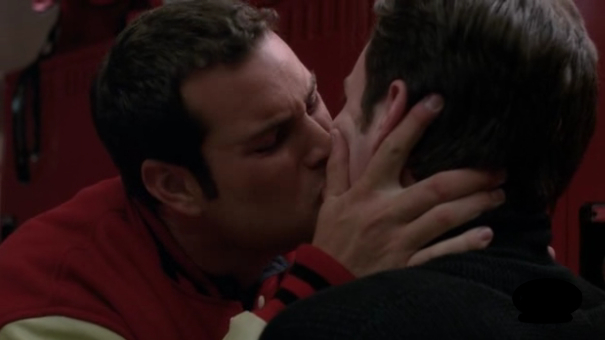
In the article "Popular Culture and Queer Representation", Diane Raymond examines three patterns of gay characters on TV: the increased appearance of GLBT characters, the "gay pretender", and the "straight-mistaken-for-gay" character. In describing the "gay pretender" Raymond says there is "never any suggestion whatsoever of any temptation or questioning on the part of the 'straight' character" (Raymond, 108). However in a recent episode of Whitney the character, Neal, comes to a realization that he might be gay. In past episodes Neal has exhibited some stereotypically gay mannerisms but because he was in a stable heterosexual relationship and because his behavior was swept aside by comedy, there was no question to the viewer that he was not straight. This example challenges Raymond's notion because this character actually ended up being gay which leads me to believe that perhaps television has already begun to diversify the ways in which gay characters are characterized or portrayed. Ron Becker studies gay visibility in American culture and a popular theme that arisen in recent television shows is gay characters "coming out". On Glee, viewers have seen not only Kurt coming out of the closet but the macho character of David Karofsky too. As I mentioned before, Neal, on the show Whitney, came out to his friends and on the show Gossip Girl the young teen, Eric, came out to the elite New York society. With more and more shows portraying the struggles gay people face with coming out and fully embracing their sexuality, the visibility of gay life is becoming more clear in American culture. Though Becker and Raymond's articles were written before these episodes occurred, the popularity of having gay characters on television has now become somewhat of a norm and the realistic struggles they face is the newest trend in gay-programming. Though much of the deeper looks into gay life are seen on sitcoms or comedies, the mere fact that they are being discussed is a big leap in terms of gay visibility and discourse on television. 
       

The Straight Guy Gay


In the article Popular Culture and Queer Representation Diane Raymond speaks of a type of symbolic annihilation in past decades to describe the invisibility of gays and lesbians in mass media. As of recently, three recurring tropes have been identified: the increased appearance of glbt as the major or supporting characters, the gay pretender, and the straight-mistaken-for-gay (Raymond, 99). While the increased representation of homosexuality is commendable I do wish that they types of homosexual representations were more diverse.   

As soon as I discovered that this week’s topic was gay-themed TV I knew instantly that I wanted to look into the character Max from my new favorite show Happy Endings. In a previous article examined in class, the bromance between Max’s character and his friends is examined. In the article the author, Ron Becker, describes Max as a gay guy who isn’t too gay.  I instantly liked this character because he went against typical gay stereotypes. Even today, many of the homosexual characters we see on television are stereotypically flamboyant, like hanging out with women, and love to shop. However, in an article from OutSpoken NYC, the author has taken opposition to the shows execution of an essentially completely straight gay man.  As I read this article I couldn’t help but feel irritated because most of the time we hear a lot about how homosexuals are negatively stereotyped and pigeonholed into one type of representation. However, Max represents a new and different portrayal of a homosexual male (one that is actually very realistic) and some are still taking offense to it. In class when discussing the representation of women in the media we said that it is better to have fewer, more diverse representations of women instead of a lot of the same. This is also true for portraying homosexuality. I believe that this is what Happy Endings is trying to do with the character Max as he represents a type of gay man that is stereotypically different and for that I commend them.
To see more of Max and his relationship with Grant check this youtube link out...and DEFINITELY watch Happy Endings on ABC :)

Monday, March 19, 2012

What is after the Bromance?


            In Ron Becker’s Becoming Bromosexual: Straight Men, Gay Men, and Male Homosociality on U.S. TV, he looks into “the bromance”, a discourse that has come of age in an era which American culture and television has become more comfortable with homosexuality in the media. While many refer to the bromance as a genre, he approaches this new ideal as a cultural discourse, “a specific way of talking and thinking about male friendships that helps produce ways of feeling and experiencing homosocial intimacy and masculinity”. He juxtaposes this notion to that of the four key assumptions scholars use to support hegemonic masculinity: gender difference, dominance, male solidarity, and heterosexism. I find his approach right on and can relate to experiences I myself have been through in which the double bind of being close to another male lends to insinuate the questioning of one’s sexuality, yet this is resolved by, “making casual fag jokes while hanging out with your buddies… (to) reassure everyone that there’s nothing gay going on”.
            In examining MTV’s Bromance Becker hits the nail on the end in addressing this as a popular cultural discourse. When thinking of this concept and the notion of being uncomfortable by the intimate male relationship I look to FX’s Its Always Sunny in Philadelphia and the bromance that promotes. Main characters Dennis and Mac, who define the four key assumptions about hegemonic masculinity mentioned above, often find themselves in homosexual situations in which they immediately denounce the notion of being gay. While we have seen the evolutions from the 90’s mistaken sexual identity plot to the bromance of the 2000’s, I think we will soon enough be able to recognize intimate masculine relationships without the hint of questioning sexuality and if that is relevant or not. Hopefully, this will be the case due to the direction contemporary television seems to be headed in, most notably ABC’s Happy Endings.

 
imgres.jpg 


Pictured Above: an image from Always Sunny Episode "Mac And Dennis Breakup"

The Boys Club Evolves? Wait, No Homo.

On the surface the Bromance appears to be a step forward in the cultural construction of masculinity. Men are allowed to show emotions that are typically relegated to the feminine half of our social binary. Men can cry, hug, and have deep conversations with their fellow "bros" and not be socially ridiculed for it, but only if they label it. These non normative behaviors seem to only be socially okay and accepted if the men partaking in them label it as a bromance or state, "no homo." Otherwise, they run the risk of being considered homosexual. This is the problem with the bromance. On the one hand it allows for men to engage in feminine behaviors without consequence, on the other hand it continues to relegate gay men as somehow "wrong." As other students have pointed out in their blogs there is a long history of men being close friends and comrades with other men most significantly its seems in ancient Sparta. However, how much do want to bet that before going into battle they didn't hug each other and then feel the need to proclaim, "No Homo?" This lends me to believe that there is something very specific to our current cultural context that requires us to announce what our sexuality is or face social consequences. Not to my knowledge has there every been a depiction in modern media of a bromance that was mistaken for a gay relationship and the men have responded with an, "Oh okay...whatever." While it is okay for men to have friends who are men, it is really only acceptable if they are both heterosexual. While "Happy Endings" seems to be attempting to fight against this, it still plays into traditional depictions of masculinity.  The bromance seems to be trapped within our cultural fixation on fixed sexuality that is concrete rather than fluid. We are either heterosexual, homosexual, or bisexual, but never anything that fits in between those categories. Freud states that our sexuality is more or less a scale and most people fit between categories rather than in a specific one. However, society refuses to see it this way. We want people in specific categories that are easy to understand and even easier to control. The Bromance seems to be an attempt to break through these concrete barriers of sexuality, however until not just men but all genders gets over this severe need to proclaim a certain specific sexuality and continually fear being mistaken for something else, the bromance and other relationships that threaten the male female sexual binary will continue to be controlled and dictated by hegemonic forces.