Showing posts with label homosexuality. Show all posts

Monday, April 2, 2012

'Cause You Were Born This Way, Baby

Throughout the first season of Glee, the series could arguably be seen as a show that conforms to society’s stereotypes whereby, “it turns its characters into what our society expects”. Finn’s character in the show can be seen as meeting the socially constructed definition of ideal masculinity such as being heterosexual and involved in sports, whereas Quinn's character can be seen as meeting the societal definition of being the ideal female.

Upon examining Chris Colfer, I argue that he is the most transformed character over the course of the following seasons, moving being a man ashamed of his homosexuality to completely embracing it and becoming a hyper-sexualized, gay icon. Kurt begins the series as a boy who feels the need to lie about his sexuality, so much so that he when he is caught by his father for wearing a unitard and dancing to the song “Single Ladies” by Beyonce in episode 4, he decides to lie to his dad that he is wearing that costume as part of football training. This scene directly exemplifies the social stigma attached to the idea of being homosexual, where in the case of Kurt, he feels the obligation to maintain a certain level of masculinity while at the same time covering up for his feminineness.

As the series progresses, the audience begins to see Kurt taking on a more sexual-liberating role by embracing his sexual orientation and flaunting it. Within the blogpost by Allison McCracken entitled, “Glee: Kurt and the Casting Couch,” she gives the example of Kurt’s performance of Lady Gaga’s “Born This Way,” in which the song represents Kurt’s coming out not as a gay man but as a sexually confident one, ready to play. He has transitioned from a character afraid to show his true self to even his family, to a man completely comfortable with who he is and can be viewed as a role model for young male audiences. At the same time, Kurt’s acceptance of the cultural feminine has made him an icon of identification and desire for the girls who can sing along with him, and who share his feelings of isolation, longing, and gender-as-performance. Kurt traditionally sings songs originally by female artists and is viewed as the more “feminine” male in his relationship with actor Darien Criss. Kurt no longer feels the need to overtly express masculine traits in order to be seen as a “true man” or be accepted by society, he is a character who moves between the gender binaries and assumes several identities over the course of the series.

This quote below is from an episode in the 3rd season, and I thought it emplifies the point I am making above that Kurt is able to be anyone he wants and does not have to fit into the structured, socially constructed binaries of society. He is being accused of not being manly enough and Burt is describing how he assumes multiple identities.

Burt Hummel: Dude you're gay.
Kurt Hummel: Excuse me?
Burt Hummel: You're gay. And you're not like Rock Hudson gay, you're really gay. You sing like Dianna Ross and and you dress like you own a magic chocolate factory.
Kurt Hummel: I don't know if you've noticed, but no one's really looking for a Kurt Hummel type to play the opposite Kate Hudson in a rom com. I'm just me.

Cultural Significance of Kurt and Blaine


      I was extremely excited for this series of readings because I am a huge Gleek.  Allison McCracken uncovers the impact of Kurt and Blaine’s voices as well as their relationship.  Prior to reading these articles, I was extremely drawn to these two characters and their relationship together; however, I couldn’t clearly explain why.  Now that I have read this series I understand their appeal and how they draw in their audience.  As I was reading the article, I speculated that McCracken was using the distinct singing style of Kurt and Blaine as a symbol of homosexuality.  She enlightened me on the history of falsetto voices and the crooner and how this type of singing was extremely popular in the 1920’s before this type of singing was censored and frowned upon.  She stated that men were strictly singing about women in a low voice and women were singing only about their love for men. Singing was no longer gender neutral beginning in the 1930’s.  The history of the falsetto and crooner were explained in the first article of this series and I found it very interesting that the picture of Kurt sitting between Blaine’s legs as they sing to each other would have been a typical picture of male singers in the 1920’s and only now are pictures like that becoming culturally acceptable. Why it has taken so long is hard to comprehend. 

            The growing acceptance of the falsetto and crooner is extremely similar to the growing acceptance of homosexuality.  Kurt and Blaine are giving a voice to the young adults who are struggling with their sexual identity, who are openly gay but who may continue to struggle on a daily basis with society, and they give a voice to individuals who are proud to be gay and give them even more confidence.  My initial attraction to Kurt and Blaine was their voices.  Kurt’s voice was extremely rare and Blaine’s voice was amazing.  Both voices drew me in regardless of the singing about their love for each other.  I was only concerned with their voices, not their sexuality which could translate to how I am only concerned with the individual as a person and not concerned with their sexual preference.  I believe the producers of Glee are trying to increase the acceptance of homosexual relationships through the voices of Kurt and Blaine.             

Friday, March 30, 2012

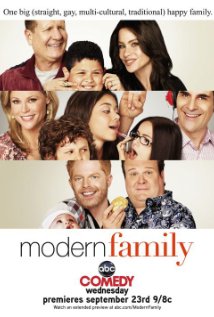
Modern Family helps their audiences accept gays

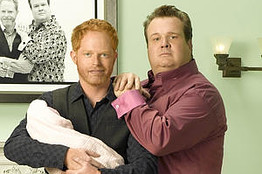
I appreciate that Raymond believes that her three glbt tropes inside comedy can potentially subvert heterosexual norms. However, I find it more significant that she argues the idea that the elimination of glbts in television is not imminent for a viewer to have their homophobic tensions resolved. As I read this piece, the show Modern Family kept coming to mind. The three families that are part of the show all live similar lifestyles except for maybe one or two evident characteristics. Cameron and Mitchell, the gay couple, share similar characteristics to the Pritchett's and the Dunphy's. They live in suburbia with the American dream and  a lavish lifestyle. Raymond states that "media critics pointed out [the] rare depictions of glbt people tended both to dichotomize anyone glbt as victim or villain and to reinforce demeaning stereotypes and caricatures" (Raymond, 101). This is not the case for Cameron and Mitchell. They are characterized as equal to the other families. They are showcased equally and are just as important as any of the other characters.

For many viewers this couple should upset them. However, people stay at ease because of the comedic and relatable characters the show casts to its audiences. Raymond argues that in order for people to accept a gay couple in any show, the show's writers would have to end each episode with a "reinforcement of heterosexuality or a containment of homosexuality" (Raymond, 100). But, instead they go another route. Raymond believes that instead the writers can try to queer the straight, or make 'queer a [normal attribute] in mainstream culture" (Raymond, 100).

Cameron and Mitchell share so many other characteristics with the middle-class man. They have jobs, dreams, money, house, child, and white-picket fence. There are overwhelming similarities between them and the viewer that makes it almost impossible for them to discredit the couple. And through the addition of comedy and societal acceptance, the viewer begins to readily watch the show and subconsciously accept this queer couple.

Glbt presence is increasing in television and slowly being accepted by the American culture. However, they cannot be flamboyant or over the top gay. Modern Family has proven that glbts can make it in television, however, there is a certain way to go about it. They cannot try to take over, but they can start being accepted through being portrayed as normal, happy, and similar to their viewers.

Raymond believes that the emergence of the glbt persona in television will "give birth to new meanings and new signifiers attached to queer sexuality" (Raymond, 109). But, I believe that in order to keep the momentum going for these characters, writers of shows need to be careful with how large of an initial impact these characters are going make on the show's plot. They need to start off with small representations of homosexuality before they try to take control, or they will have their audiences straying back to their old homophobic stereotypes and attitudes.

Thursday, March 29, 2012

HomoHeteroSexual Queerness


In her essay, Popular Culture and Queer Representation, Diane Raymond discusses the portrayal of homosexuality and, in particular 'queer' identities in today's media. The author describes three very important aspects of queer representation in the media: the phenomenon of the not-quite-so-gay homosexual character who exhibits very stereotypical 'heterosexual' behaviors such as Will from Will and Grace; the trope of people pretending to be gay as in the case of I Now Pronounce you Chuck and Larry (personal example); and finally, the classic case of a heterosexual character being mistaken as gay as in the famous episode of Seinfeld in which Jerry and George are mistakenly identified as gay men by a college reporter.

 The author argues that although the media has evolved to provide explicitly queer characters in television shows (much less in feature movies), these representations are not necessarily positive to the LGBT struggle for equality and acceptance in society. The presence of queer identities in the media was previously only possible if their stories were dominated by some sort of physical violence or if they were being ridiculed for their flamboyance. In the current media, these story lines have evolved to surround a kind of heteronormalization of queer identities.

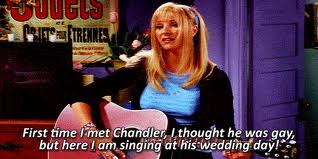
Queer characters are either portrayed to be stereotypically masculine (except for the being attracted to people of the same sex aspect) or heterosexual characters are given stereotypically homosexual attributes (except for the being attracted to people of the opposite sex aspect) or they are flamboyantly portrayed as homosexual to the point where it becomes comical. For example, the writer emphasizes the character of Will as an example of a homosexual man with strongly 'heteronormative' character traits. She also talks about his relationship with Grace and how they are portrayed almost as a married couple. She sites Chandler's character from Friends as an example of a heterosexual man with stereotypically queer traits. Finally, she uses the character of Jack from Will and Grace as an example of an overly stereotypical homosexual man. The author even makes it a point to point out that Jack's overt flamboyance is almost used as a symbol to indicate that Will is not homosexual enough and can easily be converted to heterosexuality.

Although I agree with the writer on each of these points, I have to argue that the representation of queer identities has evolved greatly since this article was written. Queer identities in the media today are much more relatable to both queer and non-queer audiences in the sense that they are hardly ever portrayed as caricatures anymore, but rather as 'regular' people who also happen to be queer and who are dealing with the everyday issues faced by humans and by people who identify as queer. Although I can not think of any completely realistic representation of queer identity, I am not particularly
bothered since there are absolutely no completely realistic representations in the media. Shows such as Glee (with the character Kurt, among others) and South of Nowhere are leading the game in the representation of 'normal' teenagers who just happen to be homosexual. They are playing a key part in getting society to begin accepting queer folk as regular (relative term, of course) people who so happen to identify as 'queer.' The same way as heterosexual people are people first and then heterosexual.