Showing posts with label lgbt. Show all posts

Friday, March 30, 2012

better gay than grumpy...


The presence of the LGBT community in media has changed drastically, especially in the
realm of television. Raymond discusses this transition from a TV culture that merely hinted
at homosexuality to one that is beginning to embrace it on a number of levels. Not only are
gay characters more widely portrayed in modern television shows, there are also more
gay writers and an increase in the number of heterosexual actors who are willing to play
gay characters. Raymond looks specifically at the intersection of the LGBT community and
comedy television, but I think that her argument is applicable to other areas of television as
well. I am especially struck by the evolution of gay characters in television shows that are
targeted at teens/young adults. Raymond argues “what is constructed [in the media] can
come to seem natural and inevitable” which is why I see the plot lines of LGBT teens to be
particularly powerful as they hold great potential.

Glee is well known for its incorporation of a strong LGBT presence. The current season of
the show features a gay couple and a lesbian couple as well as another character that is
coming to terms with his sexuality. Each of these story lines is unique and does a good job
of helping to show that “gays and lesbians are not a homogenous group with a singular,
uncomplicated sense of identity.” Glee shows its characters questioning their sexuality,
discovering the difficulties they face as gay high schools students, and the troubles
associated with exploring a new realm of physical sexuality. But the show also does a
great job of showing its gay characters finding empowerment in their sexuality (“Born
This Way” S2:E18), positive interactions with parents, and how the high school community
can be accepting with time. Glee is a great example of show that manages to appeal to the
mainstream while also incorporating a strong LGBT presence in its plot and characters.
Yet Glee is not unique, there are a number of teen sitcoms that also do an excellent job of
working towards a new portrayal of LGBT youth: Skins (UK and North American versions),
90210, Degrassi: The Next Generation, Pretty Little Liars, The O.C.,  and a number of others. Just as
Raymond argues that the queering of comedy is helping to change the role of the LGBT
community in society, I argue that the queering of teen sitcoms has the potential to make
even more powerful changes in the mindsets of youth.

There is some promise...

Ok so the instant I heard we were talking about Queerness in the media my mind went to one of my all time favorite shows "Queer As Folk". I know some of you may be asking "What the heck is Queer As Folk?" Well I can answer that for you, as stated in the reading it was an incredibly popular show on the Showtime cable channel that involved mainly LGBT characters. Also it ran for 5 "straight" seasons.

While the show does have some flaws like a lacking representation of racially diverse characters, the show never seemed to not push the envelope. Almost everything to deal with gay issues were used. Problems like coming out, drug abuse,  HIV/AIDS, Sexuality (duh!), death, pregnancy, and many more.

After reading the article for today I just wanted to throw out there that TV has jumped forward in a lot of ways. Shows like Queer As Folk, The L Word and even new shows like Happy Endings are showing a lot of promise for the LGBT community. It makes us less of a joke, or side plot of a show just to try and get ratings. Instead we are becoming the main characters who have more than one episode given to them to explore our problems.

So if you have a free weekend or just don't want to do your homework I say take some time to sit down and watch Queer As Folk it will honestly blow your mind! Seriously it's that good, and so out there. But in a good way! Ok I'll stop rambling, but really, you go, watch it...like now.

Thursday, March 29, 2012

HomoHeteroSexual Queerness


In her essay, Popular Culture and Queer Representation, Diane Raymond discusses the portrayal of homosexuality and, in particular 'queer' identities in today's media. The author describes three very important aspects of queer representation in the media: the phenomenon of the not-quite-so-gay homosexual character who exhibits very stereotypical 'heterosexual' behaviors such as Will from Will and Grace; the trope of people pretending to be gay as in the case of I Now Pronounce you Chuck and Larry (personal example); and finally, the classic case of a heterosexual character being mistaken as gay as in the famous episode of Seinfeld in which Jerry and George are mistakenly identified as gay men by a college reporter.

 The author argues that although the media has evolved to provide explicitly queer characters in television shows (much less in feature movies), these representations are not necessarily positive to the LGBT struggle for equality and acceptance in society. The presence of queer identities in the media was previously only possible if their stories were dominated by some sort of physical violence or if they were being ridiculed for their flamboyance. In the current media, these story lines have evolved to surround a kind of heteronormalization of queer identities.

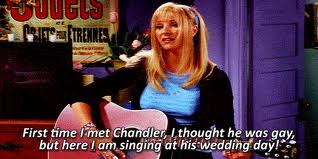
Queer characters are either portrayed to be stereotypically masculine (except for the being attracted to people of the same sex aspect) or heterosexual characters are given stereotypically homosexual attributes (except for the being attracted to people of the opposite sex aspect) or they are flamboyantly portrayed as homosexual to the point where it becomes comical. For example, the writer emphasizes the character of Will as an example of a homosexual man with strongly 'heteronormative' character traits. She also talks about his relationship with Grace and how they are portrayed almost as a married couple. She sites Chandler's character from Friends as an example of a heterosexual man with stereotypically queer traits. Finally, she uses the character of Jack from Will and Grace as an example of an overly stereotypical homosexual man. The author even makes it a point to point out that Jack's overt flamboyance is almost used as a symbol to indicate that Will is not homosexual enough and can easily be converted to heterosexuality.

Although I agree with the writer on each of these points, I have to argue that the representation of queer identities has evolved greatly since this article was written. Queer identities in the media today are much more relatable to both queer and non-queer audiences in the sense that they are hardly ever portrayed as caricatures anymore, but rather as 'regular' people who also happen to be queer and who are dealing with the everyday issues faced by humans and by people who identify as queer. Although I can not think of any completely realistic representation of queer identity, I am not particularly
bothered since there are absolutely no completely realistic representations in the media. Shows such as Glee (with the character Kurt, among others) and South of Nowhere are leading the game in the representation of 'normal' teenagers who just happen to be homosexual. They are playing a key part in getting society to begin accepting queer folk as regular (relative term, of course) people who so happen to identify as 'queer.' The same way as heterosexual people are people first and then heterosexual.