Showing posts with label Modern Family. Show all posts

Friday, March 30, 2012

Modern Family helps their audiences accept gays

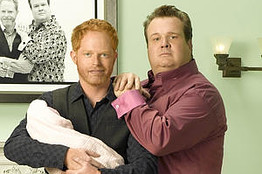
I appreciate that Raymond believes that her three glbt tropes inside comedy can potentially subvert heterosexual norms. However, I find it more significant that she argues the idea that the elimination of glbts in television is not imminent for a viewer to have their homophobic tensions resolved. As I read this piece, the show Modern Family kept coming to mind. The three families that are part of the show all live similar lifestyles except for maybe one or two evident characteristics. Cameron and Mitchell, the gay couple, share similar characteristics to the Pritchett's and the Dunphy's. They live in suburbia with the American dream and  a lavish lifestyle. Raymond states that "media critics pointed out [the] rare depictions of glbt people tended both to dichotomize anyone glbt as victim or villain and to reinforce demeaning stereotypes and caricatures" (Raymond, 101). This is not the case for Cameron and Mitchell. They are characterized as equal to the other families. They are showcased equally and are just as important as any of the other characters.
For many viewers this couple should upset them. However, people stay at ease because of the comedic and relatable characters the show casts to its audiences. Raymond argues that in order for people to accept a gay couple in any show, the show's writers would have to end each episode with a "reinforcement of heterosexuality or a containment of homosexuality" (Raymond, 100). But, instead they go another route. Raymond believes that instead the writers can try to queer the straight, or make 'queer a [normal attribute] in mainstream culture" (Raymond, 100).

Cameron and Mitchell share so many other characteristics with the middle-class man. They have jobs, dreams, money, house, child, and white-picket fence. There are overwhelming similarities between them and the viewer that makes it almost impossible for them to discredit the couple. And through the addition of comedy and societal acceptance, the viewer begins to readily watch the show and subconsciously accept this queer couple.

Glbt presence is increasing in television and slowly being accepted by the American culture. However, they cannot be flamboyant or over the top gay. Modern Family has proven that glbts can make it in television, however, there is a certain way to go about it. They cannot try to take over, but they can start being accepted through being portrayed as normal, happy, and similar to their viewers.

Raymond believes that the emergence of the glbt persona in television will "give birth to new meanings and new signifiers attached to queer sexuality" (Raymond, 109). But, I believe that in order to keep the momentum going for these characters, writers of shows need to be careful with how large of an initial impact these characters are going make on the show's plot. They need to start off with small representations of homosexuality before they try to take control, or they will have their audiences straying back to their old homophobic stereotypes and attitudes.

Queerness and Modern Family


The evolving meaning of the word “queer” is symbolic of the changing culture towards homosexuality. Not long ago, the term was used as a homophobic descriptor, and now comes to embody scholarly research surrounding mostly LBGT issues. Fascinatingly enough, queer studies does not make its stand on only gay issues, it lends itself to a certain openness that will allow for an incorporation of all. The fluidity of its range of topics parallels its view on fixed terms of sexuality. Heterosexuality and homosexuality are not exclusive to one another, and can share qualities and in fact shape how each category comes to be defined. An increasing openness and understanding of such fluidity has allowed for greater representations by the gay community in the media.

“…Shifts in roles and viewer expectations clearly allowed for the appearance of non-heterosexual characters in major and supporting roles; cultural shifts linked to an increasingly visible gay and lesbian movement no doubt helped to buttress such changes” (101). The ABC sitcom Modern Family is an interesting contemporary example to analyze. The gay characters of Cam and Mitchell are humorous, dynamic, and easily likable. Their representation on a major network is refreshing to many of the cliché characters that one can find during primetime. However, the duo of Cam and Mitchell has some oddities to it. You may see them kiss occasionally, but never passionately, and while the main heterosexual couple on the show will openly discuss sex and other innuendos, such humor is left out from Cam and Mitchell’s script. Additionally, the gay men live together and have adopted a baby, yet there never seems to be the discussion of marriage, nor a disgruntled nature towards the fact that laws are repressive towards them.

However, criticizing the representations of these gay men on a major network is maybe too critical. The better option may be to embrace the representation and hope for the best in the future with their story lines. The ABC producers have already taken the “risk” by creating these characters, maybe it is only fair that we give them due time to push the envelope further.


Wednesday, January 25, 2012

Television Women

Reading about television women as analyzed by Tuchman in the 1970s was a lot different than what my impression of television women is today. To be honest, I don't even think about the kinds of women I watch on TV, and I watch a fair amount of TV. Tuchman makes the point to say that women dominate the soap opera genre and I don't know if that's suppose to be a "yay women!" or a "seriously? soap operas?" I took it as the latter because I am not particularly proud of the women in soap operas. What does it say about our society that the only forms of television females dominate are shows about rich, catty, delusion women who cheat on husbands, kill ex-lovers, and are horrible actors? I think that is a terrible niche to try and 'claim.' I understand Tuchman's other point that in regularly syndicated television shows (in the 70s) women were only seen as housewives and mothers, "incompetent, inferior, and always subservient to men." (16) I'd also agree with Tuchman and say yes, I do think that is a problematic representation and that it could indeed affect young women's perceptions on who or what they should be.

So where does that leave us lovely women today? Well, relatively in the same pickle. As I run through all the television shows I know and watch I can't help but noticed a trend in the 'inferior' female complex. Even when not placed in the household or in the family structure, there is most often a male counterpart to the female lead, most often the one that the female pines over (if even for an episode or two), and most often helps solve the mystery or get out of trouble for the female. Even something as trashy as Jersey Shore depicts the men as more put together than the women. There are at least two episodes that focus on the women's inability to cook a proper dinner and the men having to swoop in to save the meal. Not only does this say "these men are better than these women" it also says "women should know how to cook." So even while you say to yourself "I'm never ever going to be like these people and I don't want any one else to be like these people" the show's message still reinforces the gendered roles we are all to familiar with. How come Sammie keeps getting back together with Ronnie even though he treats her like dirt? Why is it a huge deal with Snookie sleeps with two men in a night but the Situation can take two women back home at the same time, have sex with both of them, then call up his back up for a 6am breakfast and roll in the sack? The point being that while the period in which Tuchman was watching television might be a little outdated on first glance, all of those issues are still present, just embedded in different types of programming.

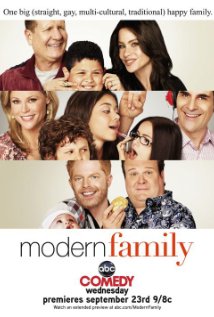
There might be some hope though. My favorite show on TV at the moment is Modern Family. I am utterly in love with all the characters on that show. And while I know I could equally argue how Modern Family reinforces gender stereotypes, I want to focus on how this show is not doing what Tuchman would expect it to be doing. I believe that all the female characters in this show are very strong and challenge gender norms (with the exception of daughter Haley who is really just there as a way to comment on how stereotypical she is). Claire, as anal retentive and bossy as she is, is the backbone to her family and is set up as being way more intelligent than her husband. More importantly, her place in the home is celebrated and portrayed as equality as important as her husband Phil's real estate career. Gloria is also the one in charge in her home and while more sexualized than the other women, she comes from a background of being on her own and independent and still acts that way with her partner. Daughter Alex Dunphy is another cool example of a twist on the notion that girls can't be educated and book smart. While her sister Haley makes fun of Alex's lack of social skills, we see very often Alex doing just fine and often question whether or not Haley is actually even literate. And we all know in life, Alex has the upper hand. This may not address the under representation of women on TV that this particularly section talks about, and Modern Family may not even be a great example of how things are changing. But I do think that when looked at as a show, women are sort of dominating the family structure, the comic relief, and have some commendable qualities that I wouldn't mind being, or my daughter being, or even mind having represented to a worldwide audience (I might also secretly relate to Claire's neuroticism and really enjoy that there is finally a character for me on TV, but whatever. That's for another time.)

Tuesday, January 24, 2012

Is "New Media" really making a difference yet?

The first thing that struck me, as I began reading the second chapter of Van Zoonen, was the mention of "new media".  Alberto Melucci coined the term which describes the type of media that publicizes existing conflicts and produce a symbolic challenge to the dominant codes of society (12).  Through this "new social movement", the media will have greater instances where the representation of society will go against the norms and expose the public to a new way of viewing ourselves as a society.  While many people would enthusiastically agree that this “new media” has already begun to permeate society, I have to ask that those who agree take a closer look at the content and subtext of this “new media”.
                Although there are several examples that could be conjured up, I will discuss a television show which I am familiar with: Modern Family.  For those who are not familiar, the show claims to display three families that are what truly make up Western society.  There is a “normal” family with a husband, wife and 3 kids, one is a male gay couple with an adopted daughter, and the other is an older man with a younger, beautiful wife.  I do not doubt that the effort is there, but I do doubt that the show is doing anything too dramatic to influence how media portrays women.  My first example is a conversation between Claire and Phil (husband & wife) who are arguing about who has the better idea/advice regarding a particular issue.  After Claire insists hers is better, Phil retorts with “Sure…I’ll take advice from a marketing major at a party school, psh.”  Although the comment’s intent could have been playful, it came off completely rude and disregarding of his wife’s accomplishments in higher education.  In further regards of higher education, one of Phil and Claire’s daughters is a “nerd” and is the smart, driven one.  Despite her occasional upper hand in arguments because of her intellect, it is much more prevalent that the audience sees her less intelligent, but popular, sister degrade her ability to “have a life” or get a man”.
 Lastly, in the latest episode of Modern Family, Claire decides to run for local office.  But in the episode during her press conference, her opponent immediately brought up a personal issue regarding her family.  This comment turned into a fiasco at the press conference that eventually led to her not getting the position.  We see this type of situation all of the time, where women in the spotlight continue to receive “cheap shots” by their competitors which many times leads to there failure.  Even when a politician looks like she gained weight or got breast implants, that’s the most important topic in question for the (mostly) male broadcasters who interview them.  By emphasizing such a scenario on Modern Family, I continue to be disappointed in the media’s progress towards better representation of women.  Does anyone else feel, despite my above argument, that Modern Family is indeed a good source of “new media”?  Are there other shows that I do not watch that do a much better job at portraying women, and therefore, contribute to the “rise of new media”? Please do share!