Showing posts with label love your body day. Show all posts

Tuesday, January 31, 2012

"When Life Throws You Curves, Embrace Them"


In class we have discussed how the media doesn't single-handedly reflect society (like a mirror) but further distorts, exaggerates, and constantly redefines reality. Gill makes an important point when talking about how we classify images in the media as “positive” or “negative” and how complex these interpretations can be. He states, “The meaning of the image does not reside in the image itself but in its interaction or negotiation of the context in which it is produced and interpreted (34).  On page 39 Gill presents the reader with a picture and a following caption that states, “positive female sexual autonomy or sexual objectification?” Ads often give us only a fragment of the feminist discourses displayed in the media, and the reader plays an active roll in generating and filling in the rest of the story. 

Different interpretations of the ads can occur between different groups of people. Some might argue that diet pill ads for example, illustrate women in the 21st century to be individuals who uses their beauty to achieve power and independence. Because the woman in the ad below is the center focus of the ad, some would say that these diet pill ads are empowering and show women as being independent from their male counterpart and able to live a lifestyle of personal expression and happiness. In addition, because this female appears alone, some might use these women as examples to illustrate the importance of expression and how women don’t actually need men to make them feel “beautiful” or happy. On the contrary, I would argue these ads do something much different.  These ads send a powerful message to women — that only the thin will be successful, happy, and in charge of their life. 


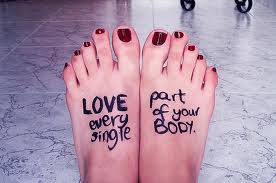
      Organizations like NOW (National Organization for Women) play an important role in recognizing and publicizing “the unrealistic beauty standards and gender stereotypes promoted by the media, Hollywood and the fashion, cosmetic and diet industries.”  They have specifically done this by continuing to celebrate “Love Your Body Day.”  Below is an example of a poster submitted to NOW to promote Love Your Body Day.  Check out this link for more poster examples and information about Love Your Body Day!


Your body needs to be loved!

Self acceptance is the theme of the 14th annual Love Your Body Day. This is a special day that is spent by women of all different colors, sizes, and ages come together to enjoy oneself and each other. It is a typical feeling by people that they are not beautiful, pretty, or sexy when watching ads and pieces of media that display an image that is characterized as 'unattainable.' Love Your Body Day is a wonderful day and should be celebrated all over the world, especially in the United States where we are a melting pot of every type of person imaginable. Whether these women that participate in this event are considered feminist is up for debate. I argue that it should not matter. For this type of occasion, people need to stop judging and provide support to the cause. Your body needs to be loved! It is the only one you will ever have. It should be treated with the utmost respect by both its owner and everyone around it. Rosalind Gill poses a question to her readers regarding women's image in media ads: Is it the shape you are or is it the shape you are in (Gill, 86)? Gill believes that the media believes in one, but if society can help shift that belief to the other, then the world can be a more loving place for women.

Love Your Body Day occurs in result to the negative media that forgets what pretty actually is. It is a refreshing feeling seeing more ads that are trying to reverse the norm of how women's bodies should be viewed and judged. For example, Cover Girl is using more plus size models and celebrities for its line of fabulous cosmetics. Recently, Queen Latifah was in a commercial and on the magazine's cover promoting her beautiful and voluptuous body. In her eyes, she is beautiful, and everyone else in the world should start to consider the message that she and Cover Girl is trying to send. Love your body and celebrate your image! 

Love Your Body


On October 19, 2011 the NOW foundation celebrated its 14th annual Love Your Body Day. On this day, “women of all sizes, colors, ages and abilities come together to celebrate self-acceptance and to promote positive body image” (NOW.org). A major aim of the campaign is to challenge the unrealistic standards and stereotypes that are present in the media. Gill argues that it is “possession of a sexy body that is presented as women’s key (if not sole) source of identity” (Gill, 255). Particularly problematic is the notion that if this “sexy body” cannot be achieved it is considered a failure.  Additionally, the female body is “constructed as a window to the individual’s interior life…indicative of her emotional breakdown” (256). The Love Your Body Day emphasizes a valuing of women for their character not their outwardly appearance.

Dove has done much in the media to help promote positive body image. In an ad in which Dove asked women what they loved about themselves the women initially responded with a resounding “uhhh…?” The ad concludes with the statement “If we can see the beauty in others, shouldn’t we be able to see it in ourselves?” The media presents an unrealistic image of women that sets a standard of beauty that many women believe they do not live up to. Organization such as NOW and Dove that help dispel stereotypes of what is beautiful and promote positive body image should be more abundant in the media.

Monday, January 30, 2012

The Trouble with the Media

            Advertisements in the media play such an influential role on the ideas of feminism in today’s society.  However, no matter how these advertisements portray feminism, it all depends on the way the public interprets the situation. 
            The reading from Gill focused on cultural politics and feminist media activism.  This feminist media activism took many different forms including sticker campaigns, guerrilla interventions, positive images, calls for more women working in the media, etcetera.  The sticker campaign dealt with posting stickers to advertisements that were degrading to women and shown in public venues.  Similar to this were the guerilla interventions, which was people writing graffiti on demeaning billboards.  Both of these were ways in which feminists used advertisements to promote for a greater diversity of women in the media and as an attempt to get people to accept themselves and others, especially women. 
            Love Your Body Day is a day in which women of all shapes, sizes, colors, ages, and abilities celebrate self.  When I read about the “Love Your Body Day” from the NOW website it reminded me of the positive images section in Gill.  In Gill’s reading, campaigning with positive images was the idea that since “ . . .women were trivialized, condemned and symbolically annihilated in the media” (Gill, 34), we need to show more positive images of women in order to show a greater diversity and add a strong, optimistic touch to the campaign.  These positive images would make women feel more confident in who they actually are contrary to what the media says, which is exactly what Love Your Body Day is about.  However, the campaign ran into problems because there was trouble in what exactly a positive image of a women was.  Many women see models as positive and attractive, however many feminists see attractiveness in images of women with wrinkles and no makeup. 
            When I read the “Love Your Body Day” article, I agreed with the women of NOW.  I thought to myself that the way people feel about themself should not be affected by these either positive images or negative images that the media shows in magazines and in advertisements.  The media is affecting so many women into thinking that they are not “normal” and that they have so many problems, which is in turn causing a lot of women to be unhealthy.  People have to love themself before anyone else will accept them for who they are, therefore they cannot pay attention to the false messages the media is sending about beauty.  If women do this and disregard the media, they will become more confident in their own eyes and with their own body. 
The picture I added is very true and reminded me of the NOW article, as it is from the Love Your Body campaign, and Gill’s reading.  Because of what the media says, women are so concerned about what they look like to others that they are forgetting the most important thing in life which is to be happy with oneself.